Categories
diary Meg

Meg’s Diary 1942

by Margaret Taylor, age 27 years
June 23rd 1942

There’s only one entry this year, but quite a long one.

Thoughts about war and morality.

A lot of health issues in the family to worry about.

Back to the top…

Sunday, June 23rd, 1940

Nine months or so since I wrote last, but the situation is unchanged as far as the apparent imminence of air raids is concerned. Those we dreaded at the beginning of the war never materialised, for Hitler has been busy in other directions. Now, however, with nearly all Europe in desolation and miserable subjection to him, he is almost certain to start his long anticipated invasion of Great Britain by air, sea or land. We are prepared now and not downhearted, for the series of catastrophes which have so far represented the Allied side of the war have not been due to our failures, but to those fighting with us, and amazing they have been. The evacuation of Dunkirk was so incredible and magnificent that it converted a defeat into a moral victory, and gave us all fresh heart to strive ever harder in the face of disaster.

Now the French have signed the Peace Treaty with Germany, and are negotiating one with the Italians. That which all swore would never be – the separation of England and France, and the capitulation of the French people – has happened. And with this undreamt-of desertion fresh upon us, we are already enumerating the advantages of fighting all together in our own territory, and almost persuading ourselves that perhaps the clouds have all got the proverbial silver lining. If any people ever deserved to win a life or death struggle I think we British are those people. No nation can be completely good or completely bad, and certainly nobody can judge his own people justly, but, all allowances made, I feel more proud of being English and more determined to resist as far as I can Nazi conquest and influences than ever before.

The old question of the unforgivable crime of killing human beings, whatever may be the quarrel with them I have recently given up, as being beyond my power of reasoning at present. Logically, there is nothing under heaven which will absolve a man of killing another, if the standard of values accepted in true civilisation is used as the basis of argument. But in politics, and especially in power politics, the arguments used are certainly not based on the tenets of true civilisation, and to cope with the actions of those following power politics it seems that civilisation must drop back to the lower standard. It is really perhaps that we cannot take a long enough view. Civilised thought and values are based on ultimate right and wrong, and the rewards it brings are immediate only immaterially, in harmony of mind, whilst the material rewards are often long-delayed though just as sure. Jesus only triumphed mentally over the Romans at the time of his death. Then they seemed to have the material victory. Later it became obvious who had really won, for might can never conquer right, only obstruct its development.

At present men cannot be content with the knowledge that however great the forces of degraded blood-spillers and power-graspers may seem, if they maintain their own spirit uncorrupted and free, expressing their individuality fearlessly, the victory of the enemy will be temporary only. Man is a short-lived creature, and can see only glimpses of the infinite age of spiritual things, and to him subjection, even though material only, to evil seems a betrayal of civilisation. Yet a material victory over evil means war, killing, and employment of the very methods which civilisation has condemned.

Truly, it is a tough nut to crack!

Back to the top…

About my personal history there is quite a lot to say, for once again I have reached a ‘jumping off place’  in the pilgrimage. I took London Finals in May, and failed in both parts of B.S. and passed in M.B. I found it a very bitter thing to accept, that I had actually failed Finals. For so long I have worked hard, and told myself I must know enough to be certain of passing, for failure was unthinkable. Yet now I know that there were bits I shirked because they didn’t interest me – and behold they ploughed me straight away! There was some bad luck in it too, and that helped me towards resignation, but even now, after about three weeks, I am only just above pitying myself. One of the most difficult lessons to learn is that whatever label and grade the others give you, whether they look up or look down on you, you are just the same and of just the same value as before. 

If you are honest you are never satisfied with yourself, and it should be this striving to satisfy your own standards for yourself, and not desire for the acclamation of others, that prompts progress and learning.

So now I am at home, reading surgery and gynae in the evenings, and helping Mums in the servantless abode in the mornings. There is really too much for her to do alone, though without me there would be only three people, so I don’t like to skoot off back to London, though I should be attending all O.P.s etc possible.

In October last year No. 9 was sold, and Staynes and I migrated into the hospital to live in Mary Scharlieb under the emergency scheme. I have been ‘living in’ in hospital ever since then, in the ward until a month or two ago, and then in Sister’s room of Queen Mary Ward, and a very comfortable little room it has been. After being alone a great deal in my room at No. 9 the communal way of living in hospital was cheerful and enjoyable, and we have become real friends, some of necessity, some of inclination!

Back to the top…

Family news has been plentiful also since I wrote last. About January Jim got influenzal meningitis and was in hospital in Exeter. Dad was ill with ‘flu and stayed with Pat while Mum and Alan went down to see him. Jim, after a desperate two or three days during which our lives consisted of telegrams and waiting for telegrams, was pronounced out of danger and recovered completely at record speed. Mum returned to find Daddy very pulled down by ‘flu, and far from well. His chest troubles increased and he got pleurisy and then hypostatic pneumonia with failing heart, on top of an attack of asthma. He became dangerously ill and they phoned for me to come home at once, and bewildered, feeling in an unreal and nightmarish world, I arrived and was met by Alan somewhere around 8 a.m. The week which followed I can’t describe, and there would be little point in doing it. Mum and I took turns in sitting in the bedroom and often my legs and body were shivering so violently I could not keep them still for more than a minute or two. I didn’t take in a word of the book I sat with, and I never even turned the pages. Daddy was cheerful and never complained of pain or anything else though he had bilateral pleurisy part of the time, and had to change his position every five or ten minutes. His attacks of coughing literally exhausted me, and I dreaded the beginning of each one. Mum and I knew several hours before Dr. Alexander told us that he was getting better. We stood and looked at him and whispered excitedly that his cheeks and ears were pinker, and so they were!

Alan left for naval training at Skegness about a week ago, and is enjoying himself immensely: they seem very decent to their men in the Navy, and the contrast between Alan’s converted holiday camp, and Jim’s strenuous drudgery is very great.

Mums is really the heroine of the piece, but there is nothing else one can say about her without getting sentimental.

Goodnight!

Back to the top…

Categories
1939 diary Meg

Meg’s Diary 1939

by Margaret Taylor, age 25 years
April to September 1939

Meg is still studying to qualify as a doctor at the London School of Medicine. She gets to perform her first surgical operation.

Everything changes at the outbreak of World War II

(Second edition: updated 20th Sept 2020)

Back to the top…

Sunday April 30th 1939

Bulkeley and I have just spent a wonderful day in the country staying with Miss Ross, to collect foliage for decorating the common room of L.S.M. for a formal dinner. I have just written about it at length in my letter home and as it is a day I want to remember, I am going to reiterate it all here. 

We left hospital soon after 4 pm, taking our pyjamas and toothbrushes according to instructions! Miss Ross drove us out at a furious rate, and although it was showery the bright intervals between the showers were glorious. She lives at Herons Gate, about 20 miles out of London and near Watford and Rickmansworth. The house was a small one not far from the main road, but so secluded that it was difficult to realise that civilisation was anywhere near.

We met Miss Ross’s sister on our arrival, and though we smile at our Miss Ross and think she dresses rather oddly, it was difficult to refrain from laughing outright at her sister. She had a khaki outfit on, tunic and short skirt and the collar of a shirt-like garment strongly resembling pyjama tops appeared at the neck. She had a long thin face with parchmenty skin and very wrinkled like our Miss Ross’s, but she was much stouter, in fact almost barrel-shaped, and her hair was not cut in an Eton-crop, but stood out wavy and stiff all round like a greyish golliwog’s.  Her voice was identical with Miss Ross’s – very deep and strong, in fact we never knew which was speaking when they were both in the room.

Our Miss Ross soon changed into her house clothes, and though they did not seriously rival her sisters they were outstandingly countrified. We wondered whether all Scotswomen at home in their highlands dressed similarly.

Anyway we thanked our stars that we could let all visiting manners fly to the winds, and felt at home immediately.

We were each provided with a pair of strong pruning pliers and taken out within five minutes of our arrival. Miss Ross pointed out the best woods for birches and beeches and directed us as to what to do when we got lost! She then said come back when we wanted to, and they could keep supper for us, and left us standing at the top of the open field behind her house, gazing across at the miles of greenery in front.

The country was really interestingly lovely. We met a gypsy encampment at the end of the lane and they said “Good evening, Miss” as we passed. The pony did not look so polite, but he didn’t do anything. There were whole carpets of bluebells and some clumps of primroses scattered about, and more violets than I have ever seen growing wild. We climbed fences and clambered over gates and through hedges. It started raining pretty hard at one time, but we just couldn’t waste time sheltering, but turned our coat collars up and took no more notice. We cut heaps of birches and beech boughs and as we hadn’t any string it was difficult to carry them, but we only enjoyed carrying them more because of it, and even having to toss the bundles over the gates and hedges before climbing them was great fun. We did not go back till it was nearly dark and as we crossed the field to the back gate of the house several of the cows we passed started following us, and we wondered frantically whether they were merely expecting us to feed them with our hard-won foliage, or whether they didn’t like the look of us and would charge. We certainly covered the last 20 yards at more than normal walking pace and were glad to shut the gate impolitely in their faces as they arrived there about 2 seconds after we did.

Supper was badly cooked by the other Miss Ross but we were ravenous and enjoyed every bit of it. Afterwards we sat by the log fire and listened to the news, and then helped Miss Ross by reading through and checking the references in the latest edition of her textbook, which is in the process of being printed.

Bulkeley had first bath and went to bed fairly early as she was tired and was conserving her strength for finals on Monday.

Later Miss Ross made tea and we all had a cup before retiring. My bedroom was small, and the walls were whitewashed blue. There were two windows, and a veranda in front of one of them. Both looked out onto miles of countryside, and I hadn’t the heart to close the curtains though leaving them open made the room rather light, and the moon was reflected in the panel of glass in the wardrobe.

I slept so soundly that it took me several minutes to remember where I was after Bulkeley had shaken and me awake about 7 a.m. We dressed in about three minutes and set off to collect bluebells to carry back with us. Miss Ross called out to us as we were going that we could take an apple each out of the apple shed at the end of the garden. We accepted the offer with relish, and the apples were heavenly. The wood was still very wet and frosty, and the fields looked so much more inviting in the sunshine that we walked a long way across them before we returned to the woods and the bluebells. Miss Ross came out with one of the Sealyhams, to collect us for breakfast, and after breakfast we tied up the branches in bundles and stowed them away in the car. Then we waved goodbye to Miss Ross’s sister and had a hilarious ‘zooming’ ride back to London and sanity. We are both longing to be asked out there again!

Goodnight!

Back to the top…

Sunday, June 11, 1939

I feel really worn out just now, and am joyfully anticipating 10 days or a fortnight’s holiday at home, to start tomorrow. The main reason has been futile worrying over Mum’s thyroid trouble. About three weeks ago, like a bolt from the blue, came a letter asking advice about which surgeon to consult, as she had been having ‘attacks’ of pain in the neck and some mild pressure symptoms.

This worried me very much indeed, for although I guessed the reason for the symptoms was very probably an oedema with recurrent haemorrhage into it, I just could not get the possibility is malignancy out of my head; and I had heard that Aunt Jessie died of something sounding suspiciously like a malignant thyroid.

Then came the relief of Mr Cooke’s report, and the knowledge, too, that he was such a charming person and an absolutely reliable and able surgeon. I arranged my holiday so that I could go home just before Mums had to go into hospital; but the day before my scheduled departure came a letter from Miss Mollen calling me to an interview with the Scholarships Committee on Monday June 12th –  two days after Mum’s operation.

It was impossible to return for the interview for less than £1, so I have just to make the best of staying up here during the weekend, when I would have been of the most use at home, and when I was longing to be near at hand to hear of her progress. Daddy rang me up last night to say that Mr Cooke was very pleased with Mums, and that she had had paraldehyde pre-op and was sleeping peacefully when he saw her in the afternoon. Podge’s high-pitched little voice chattering away was a real tonic, but to hear from Dad that he had been in to see Mum made it all seem so real that the whole thing stared me straight in the face for the first time, and frightened me a bit. Before that I had not been able to realise fully that it was really Mums who was having the op. we were all planning so busily. Anyway, it is mostly over now, and well over too, thank goodness, so no more worrying. Daddy is sending me a postcard tonight and I am wanting that, for it was too early to say much really last night. Mrs Beaman rang me up this morning  – she turns up trumps every time.

Since my last entry on work, I have done Junior Comb. and I’m now almost finishing Senior Surgery on Mr Norbury’s post. Junior Comb. was good fun though not wildly exciting. Mr Venall is an interesting and likeable old-fashioned type of doctor, with a refreshing amount of common-sense. He was the main attraction on that post, and his outpatients were the pièce de résistance each week. Horton disappointed me bitterly. I had read a small amount of psychological medicine before I went there, and had found it fascinating and stimulating reading. But Horton is a dreary old and most unfriendly place, at least when visited in the winter, and the patients were just as dreary, and appeared ill cared for and like animals rather than people. In fact ‘lunies’, though of great interest in the abstract, I found most uncongenial in the flesh, and my tentative speculations on delving more deeply into that branch of medicine came to a speedy dissolution. Dr. Heald with his electrical therapy and his exasperatingly slow and ambiguous conversation, reminded me of the Middle Ages and reliance on witchcraft and a bit of luck thrown in. He never diagnosed a case while I was with him  – though admittedly he gets all the undiagnosable chronics the hospital owns.

It is, I suppose, good for my soul to have to acknowledge that such an apparent fool is recognised by those well qualified to judge, as a very clever person! Mr Williams, X-ray expert(?) was an unfailing source of entertainment, but supplied no information whatsoever on X-rays. Sister Win was a rather bulky but very luminous star on the horizon throughout the post and her duets with Mr Venall on Tuesdays and Fridays were occasionally magnificent.

And now I am in the third month of Mr Norbury’s post, and am enjoying it as much as any post I have done, and more than any except Casualty or Junior Medicine perhaps. I was made senior, not because I was properly elected by a majority vote but because Westerman, who was elected, had transferred to the Cancer, and the other three seniors were all taking exams. But I certainly have been doing a full senior’s work, and it entails quite a lot of organisation and overseeing.  I have been fully repaid for my troubles though, for the juniors come to me all the time for advice, and obey instructions willingly though their conscientiousness is remarkable for its absence on many occasions. Even at school I could manage to be an authority without ‘bossing’ too much, and it is working just the same here, though perhaps I treat them too much like schoolgirls. It is gratifying when they say how they will miss me when I go on holiday – but I know too well what those compliments are worth to get swollen-headed about it!

Mr. Norbury is a person I shan’t forget, for he embodies most of my ideal qualities of a doctor, and is yet our inimitable Mr. Norbury at the same time. He is like a perky grey-haired little bird, hopping round and chirping joyfully day in and day out.

No patient is merely a ‘case’ for him, and no two ‘appendices’ are exactly alike. Surgery, one feels, is just as thrilling for him today as it was on his first house job, and his humility has not gone with his increase in knowledge and experience. There is nothing which stamps a fine person so surely as their humility (c.f. Mr. Joll !!)

I shall be sorry to miss the next 10-14 days of his post, but I want much more to go home, so go I certainly shall. E.N.T.s is to be the next 3 months’ effort – + pathology and fevers. Exams seem dangerously near, and I am working pretty hard now-a-days, to prevent a hectic scramble just before November. 

I think I’ve written enough for today…

Goodnight!

Back to the top…

Sunday, July 23rd 1939

I feel I want to write a little tonight, just to communicate my first real operation in a theatre – I have done a few ‘minor ops’ in casualty before of course.

On the last Wednesday on the Norbury post Mr Norbury asked me whether I would like to do a small operation. This is a reward he offers his seniors now and again, but not every senior gets it, so it is quite an honour.

Of course I said I should love to, and as it was the end of the post he said I must remind him about it and come back and do it later. I asked Bottomley to remind him and he said I could do a lipoma or something equivalent. This damped me a little, as I had been helping him for an appendix or a hernia, but still I was excited about it, and very qualified for the opportunity. Bottomley wrote specially for a lipoma case from the General List and one came in last week.

It was only a small lipoma of the thigh, but it was unusually deeply situated, and was causing pain in the leg so the patient wanted it removed, though Mr. Norbury when he saw it advised her to keep her leg intact.

When she was anaesthetised Mr. Norbury could not locate the lump, and for a few minutes I thought it was going to be a complete wash-out. But at length he felt it, and made a scratch marking its position. I made an incision where his scratch mark was, about 4 – 5 ins long, and went on through the subcutaneous tissues. He and Bottomley secured the bleeding points, for I had enough to do to just perform the cutting part. I had to go very deeply for the lipoma turned out to be within two adductor muscle sheaths, and I was dreading that every bleeding point as it arose might be the femoral vein or artery which I had slashed! Mr. Norbury told me what plane to dissect on, and after several minutes wandering amongst fatty subcutaneous tissues the upper lobe of the encapsulated lipoma popped out from the muscle sheath, to be greeted with joyful exclamations by Mr. Norbury and a sigh of relief by myself. I then dissected out the lipoma, cutting where directed, and causing Mr. Norbury some anxiety by my determination to cut the muscle fibres rather than the lipoma – goodness knows why – perhaps I wanted to keep the specimen intact, or had vague fears that it might puncture like a cyst! On removal it turned out to be about 2 ins. in diameter, and it was most satisfying after the former doubts, that there had really been something there to remove.

Mr. Norbury left Bottomley to help me sew up while he started on the next op – a fistula-in-ano. I had some difficulty in getting the ligatures to sit over the end of the Spencer Wells and not at their tips – a difficulty I had never anticipated, or noticed other surgeons experience! But it felt very grand to be handed ligatures by the student doing instruments, and putting on the Michel clips fulfilled an ambition I have harboured for ages.

Those who knew that I was going to do an op said how dreadful it would be to have to perform in front of the assembled Norbury post, but actually I was too completely absorbed in the work on hand to even think of the others watching me. I didn’t do it very well, and must have appeared very amateurish to anyone watching, but I don’t think Mr. Norbury was annoyed with me, though I don’t think he could have been very pleased. Anyway I didn’t feel at all nervous, and my hands certainly didn’t tremble or fumble overmuch, so it was not as bad as it might have been. It was very nice of Mr. Norbury to think of letting a student do an op which to him must seem absolutely childish, and it must be very aggravating to keep your hands to yourself when you can do perfectly what someone else is making a great to-do about.

Well, that was what I wanted to say, so

Goodnight! 

Back to the top…

Saturday, Sept. 30th 1939

Not so very long since I wrote last, but things have changed somewhat! The war has been in progress for nearly a month, and we are beginning to lose the initial tenseness and are resigning ourselves to a prolonged period of hostilities and frightfulness. Thank goodness we all got our holidays just before all this began, for otherwise we should have been verging on nervous wrecks I expect – I feel already that I should enjoy another holiday!

Somehow all the prophecies and gossipings about the chances of war , that have been current for months past, did little or nothing to soften the shock of the actual outbreak of war when it came. 

The quiet, determined and fatal tone of Mr. Chamberlain’s speech at 11:15 that Sunday morning we shall all remember for a very long time. Air-raids we have not yet experienced, and I for one am dreading them with heart and soul.They are, I fear, almost inevitable; but the thoughts of the injuries and destruction they cause are too vivid to contemplate.

The most  helpful attitude at present seems to be one that recognises only each day as it comes, and looks no further. Thank goodness we students here have enough to occupy our days, and keep us from mooning. The hospital staff remaining – Dr. Hancock, Miss Barry, Miss Vaux, Miss Ball, Mr. Quist, Mr. Adler, Miss Moore-White – have taught us liberally and we feel that this horrid time of waiting about for air raid casualties has not been wasted.

Arlesey plans have collapsed more or less completely and now they are arranging for us to start posts as usual at R.F.H. next week. Goodness knows how long we shall have undisturbed. At present we volunteers are having all meals free, but next week I suppose we shall have to return to paid rations.

London is changing its old unchangeable face. Great sandbag edifices rise up all over the place, while paint is daubed on kerbs, railings and lamp-posts, and windows are decorated with thick black curtains of paper. The streets are lit only by the moon, and on a moonless night a walk is like Blind Man’s Buff, and crossing a road is done at your imminent peril – as our many casualty cases demonstrate. When peace comes again we shall certainly know how to appreciate it.

What a crazy world!   Goodnight! 
Categories
1940 diary Meg

Meg’s Diary 1940

by Margaret Taylor, age 25 years
June 23rd 1940

There’s only one entry this year, but quite a long one.

Thoughts about war and morality.

A lot of health issues in the family to worry about.

Back to the top…

Sunday, June 23rd, 1940

Nine months or so since I wrote last, but the situation is unchanged as far as the apparent imminence of air raids is concerned. Those we dreaded at the beginning of the war never materialised, for Hitler has been busy in other directions. Now, however, with nearly all Europe in desolation and miserable subjection to him, he is almost certain to start his long anticipated invasion of Great Britain by air, sea or land. We are prepared now and not downhearted, for the series of catastrophes which have so far represented the Allied side of the war have not been due to our failures, but to those fighting with us, and amazing they have been. The evacuation of Dunkirk was so incredible and magnificent that it converted a defeat into a moral victory, and gave us all fresh heart to strive ever harder in the face of disaster.

Now the French have signed the Peace Treaty with Germany, and are negotiating one with the Italians. That which all swore would never be – the separation of England and France, and the capitulation of the French people – has happened. And with this undreamt-of desertion fresh upon us, we are already enumerating the advantages of fighting all together in our own territory, and almost persuading ourselves that perhaps the clouds have all got the proverbial silver lining. If any people ever deserved to win a life or death struggle I think we British are those people. No nation can be completely good or completely bad, and certainly nobody can judge his own people justly, but, all allowances made, I feel more proud of being English and more determined to resist as far as I can Nazi conquest and influences than ever before.

The old question of the unforgivable crime of killing human beings, whatever may be the quarrel with them I have recently given up, as being beyond my power of reasoning at present. Logically, there is nothing under heaven which will absolve a man of killing another, if the standard of values accepted in true civilisation is used as the basis of argument. But in politics, and especially in power politics, the arguments used are certainly not based on the tenets of true civilisation, and to cope with the actions of those following power politics it seems that civilisation must drop back to the lower standard. It is really perhaps that we cannot take a long enough view. Civilised thought and values are based on ultimate right and wrong, and the rewards it brings are immediate only immaterially, in harmony of mind, whilst the material rewards are often long-delayed though just as sure. Jesus only triumphed mentally over the Romans at the time of his death. Then they seemed to have the material victory. Later it became obvious who had really won, for might can never conquer right, only obstruct its development.

At present men cannot be content with the knowledge that however great the forces of degraded blood-spillers and power-graspers may seem, if they maintain their own spirit uncorrupted and free, expressing their individuality fearlessly, the victory of the enemy will be temporary only. Man is a short-lived creature, and can see only glimpses of the infinite age of spiritual things, and to him subjection, even though material only, to evil seems a betrayal of civilisation. Yet a material victory over evil means war, killing, and employment of the very methods which civilisation has condemned.

Truly, it is a tough nut to crack!

Back to the top…

About my personal history there is quite a lot to say, for once again I have reached a ‘jumping off place’  in the pilgrimage. I took London Finals in May, and failed in both parts of B.S. and passed in M.B. I found it a very bitter thing to accept, that I had actually failed Finals. For so long I have worked hard, and told myself I must know enough to be certain of passing, for failure was unthinkable. Yet now I know that there were bits I shirked because they didn’t interest me – and behold they ploughed me straight away! There was some bad luck in it too, and that helped me towards resignation, but even now, after about three weeks, I am only just above pitying myself. One of the most difficult lessons to learn is that whatever label and grade the others give you, whether they look up or look down on you, you are just the same and of just the same value as before. 

If you are honest you are never satisfied with yourself, and it should be this striving to satisfy your own standards for yourself, and not desire for the acclamation of others, that prompts progress and learning.

So now I am at home, reading surgery and gynae in the evenings, and helping Mums in the servantless abode in the mornings. There is really too much for her to do alone, though without me there would be only three people, so I don’t like to skoot off back to London, though I should be attending all O.P.s etc possible.

In October last year No. 9 was sold, and Staynes and I migrated into the hospital to live in Mary Scharlieb under the emergency scheme. I have been ‘living in’ in hospital ever since then, in the ward until a month or two ago, and then in Sister’s room of Queen Mary Ward, and a very comfortable little room it has been. After being alone a great deal in my room at No. 9 the communal way of living in hospital was cheerful and enjoyable, and we have become real friends, some of necessity, some of inclination!

Back to the top…

Family news has been plentiful also since I wrote last. About January Jim got influenzal meningitis and was in hospital in Exeter. Dad was ill with ‘flu and stayed with Pat while Mum and Alan went down to see him. Jim, after a desperate two or three days during which our lives consisted of telegrams and waiting for telegrams, was pronounced out of danger and recovered completely at record speed. Mum returned to find Daddy very pulled down by ‘flu, and far from well. His chest troubles increased and he got pleurisy and then hypostatic pneumonia with failing heart, on top of an attack of asthma. He became dangerously ill and they phoned for me to come home at once, and bewildered, feeling in an unreal and nightmarish world, I arrived and was met by Alan somewhere around 8 a.m. The week which followed I can’t describe, and there would be little point in doing it. Mum and I took turns in sitting in the bedroom and often my legs and body were shivering so violently I could not keep them still for more than a minute or two. I didn’t take in a word of the book I sat with, and I never even turned the pages. Daddy was cheerful and never complained of pain or anything else though he had bilateral pleurisy part of the time, and had to change his position every five or ten minutes. His attacks of coughing literally exhausted me, and I dreaded the beginning of each one. Mum and I knew several hours before Dr. Alexander told us that he was getting better. We stood and looked at him and whispered excitedly that his cheeks and ears were pinker, and so they were!

Alan left for naval training at Skegness about a week ago, and is enjoying himself immensely: they seem very decent to their men in the Navy, and the contrast between Alan’s converted holiday camp, and Jim’s strenuous drudgery is very great.

Mums is really the heroine of the piece, but there is nothing else one can say about her without getting sentimental.

Goodnight!

Back to the top…

Categories
1938 Meg Paul blog

Meg’s Diary 1938 is published

The next instalment of Meg’s diary, the diary of a young student doctor studying at London School of Medicine in the year before the war, is now published.

Categories
1936 1937 Meg poem

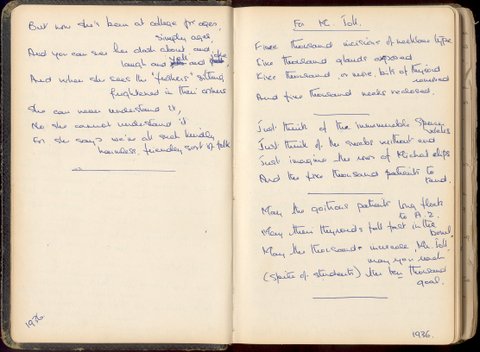
For Mr Joll

poem 2

For Mr Joll

Five thousand incisions of necklace type
Five thousand glands exposed
Five thousand, or more, bits of thyroid removed
And five thousand necks reclosed.

Just think of the innumerable Spencer Wells
Just think of the swabs without end
Just imagine the rows of Michel clips
And the five thousand patients to tend.

May the goitrous patients long flock to A.2.
May their thyroids fall fast in the bowl.
May the thousands increase, Mr Joll, may you reach
(spite of students) the ten thousand goal.

Meg Rugg-Easey 1936

(Mentioned in Meg’s 1937 diary)

Categories
1929 diary Meg

Meg’s Diary 1929

PRIVATE
DIARY

Margaret Taylor, 12 Osborne Rd, Clifton, Bristol
Age 14 years
Begun Friday, July 20th 1929
Finished Saturday, November 25th, 1933

Friday, July 26th, 1929.

This new book was bought for me by Dad, he had said before that he would buy the book if I would write the diary.

There is only one more exam left now – geometry. It will need a lot of revision but I will have all the week-end to do it in.

I have one of the dolls that are given to anybody who will undertake to dress them. They are for the club children. There is lots of time as they need not be given in ’till the beginning of next term.

The third lost their match against The Colts which was truly awful. I made a duck, but retrieved my honour by taking three wickets. I don’t know for how many ’cause Vere King took the books home to work over.

Good-night.

back to the top…

Saturday, July 27th 1929

There is no time really to write tonight, it has just struck eleven. We have been listening to a revue on the wireless. It was very good – especially Mabel Constanduros, if that is how she spells her name.

I must not spend any more time now, for me have all arranged to go to the baths Kingsdown are open on Sundays, before breakfast tomorrow. Oh dear I wish I hadn’t said I would go, but I expect I will enjoy it when I get there.

Good-night.

.. back to the top …

Wednesday, July 31st 1929

We broke up yesterday, so, of course, it has been pelting off and on all day. Jim is not coming back for about a week because he has gone to camp with the O.T.C, at Tidworth where all the other public schools are camping together, there are thousands there. Jim is lucky, he won’t have much hard work to do as he is now a Lance-corporal.

I will buck up and get into bed and then get on.

Now I am ready again. Yesterday Suzanne Oliver came to tea, and we went to watch a tennis tournament in which she was playing the next day (today). We discovered she was playing that day after tea so she dashed home, changed, had tea with me, and was back again in time. She with Cherry Peter beat their opponents, both High School girls 6-2, 6-2 So they will be in the next round. I did quite well in the exams. Mary was by far the best – she had (out of the ten exams) eight firsts (over 70) and two seconds (over 50). I came next with six firsts, and four seconds. There was nobody else near us, I think. So I am quite sure of my remove next term. The form-mistresses are Miss Davidson and Miss Thomas. I don’t know Miss Davidson very well, she does look shapy though. I am longing to go into Miss Thomas’ form, she is really fine, the best mistress in the school.

Examination Results

History Grammar Literature Geography French Latin ScienceII II II II I I IAlgebra & Arith Geometry ScriptureI I I
Exam results

.. back to the top …

Monday, August 5th Bank Holiday 1929

I have been waiting until something really happened before I wrote here again, so now here you are! It began, I think, on the day that Ashman (a dreadful prig) came to take Alan for an afternoon on the river at Saltford. When he came back he was full of it, how lovely it was, and we ought to go.

He was so awfully keen on it we said we would go, on Saturday. Well Saturday looked very cloudy and rainy and so we put it off, Alan was mad about it.

After all it turned out quite a decent day, which made him worse. The next day we did set out although it did look cloudy again. Mum and I took our macs, and Pat’s, but Dad and Alan said they did not think it would rain. When we were nearly there, on our bikes, it began to fairly pelt, and we were forced to shelter because the men (if Alan can be included in ‘men’) where without macs. It looked as if it had come to stay, and after waiting, it must have been quite an hour, Dad said he would rummage round and see if anybody would look after our bikes while we bussed home. At last he managed it, some very posh people, with a fine garage, offered help, and Dad promised to call and collect them next day if it were fine. We arrived home very bedraggled and weary, and now Saltford is another name for the baths.

Today was quite fine, and so we decided we would have another go at the river while we were there. So we bagged the best part of the day by packing out tea, and leaving about half-past-eleven.

We collected the cycles on the way, and then went down to the river. It was absolutely fine, and no crowd at all, even though it was a Bank Holiday. We rested by a bank and had lunch, without anyone passing, and we weren’t quick. The scenery was beautiful, and there wasn’t much current. I rowed for most of the time, chiefly one oar, but for a short time with two. It is more than twice as tiring with two than with one.

My wrist is getting so tired I will have to stop, ‘though there is lots more I wanted to say. Never mind, tell it another time.

Good-night

.. back to the top …

Saturday August 10th 1929

I have ever so many things to write about that I had better start right at the beginning of the day and go onwards.

I am afraid there is nothing exciting, but everything is important (to me, now).

Firstly we (Dad, Alan and I) went to the open air baths before breakfast. It was lovely and warm. I stayed in much longer than either of the others.

Secondly I went with Mum (and of course, Pat) down to Bobby’s to see their new winter, or rather autumn, hats. There was not one small enough to fit Mums; not the right colour, so she is leaving it for a few days, as they will be having a lot more. I bought one, red, a lovely one, and I like it more than any other one I have had. Then we came back to Clifton and we bought a pair of nice light brown shoes, strap, for me again.

Thirdly Dad went with me to see The Cricket match, Gloucestershire versus Northants, at the College. They are very even, and I don’t know which will win. They have only just started, this being the first day.

Fourthly (and lastly, I believe) I saw a book of Jefferey Farnol’s* ‘Black Bartlemys Treasure’ in a stationary shop selling for 9d, as a surplus library book. I bought it, and so have realised a dream I have had for a long time, to own one of Jefferey Farnol’s books. He is easily my favourite author and has been for three or four years.

Ian may come next. There is no third.

Good-night

*John Jeffery Farnol (10 February 1878 – 9 August 1952), was an English author, known for his many romantic novels, some formulaic and set in the English Regency period, and swashbucklers.

.. back to the top …

Thursday, August 15th 1929

Dad and Alan came home today. Oh, I don’t think I even told you they went away, I’ll tell you (that’s me) now.

Dad went up to London to demonstrate the game to the buyers of the big stores, Barkers, Gamages, Selfridges, Harrods, and others, and he took Alan, as he is the most proficient, up to demonstrate with him. Harrods and Selfridges are most keen, and say it should go well at Christmas. The Kum-Bak people have offered Dad to manufacture them, and give him so much on each one they sell, and also a minimum so they will not be able to stop selling them. We don’t know whether to accept or refuse, but I should say accept.

Good-night

.. back to the top …

Monday, August 19th 1929

We (children) went to the pictures this evening. We saw the first talkie performed (of rather had) at the Triangle. I had never seen or heard one before, neither had Jim. Alan did when he was in London with Dad. It was ever so good, especially the plot. The talk was rather gramophoney, and not always clear. Alan said the one in London was much better. We all have headaches now through listening to it for so long.

A man (in the talkie) made a bet to speak only the truth for twenty-four hours, and he got in a dreadful mess by the end of it*.

I am awfully tired so-

Good-night

*Nothing But the Truth (1929) is a sound comedy film starring Richard Dix. The film was remade as Nothing But the Truth (1941) starring Bob Hope and Paulette Goddard.

.. back to the top …

Sunday, September 8th, 1929

We are at the farm now – minus Dad, who had to go to London on business (about the game), a day or two after we arrived, and will only come back on Wednesday evening – we have to go on Friday.

The old car we hired, a Standard, was so hard to drive that Mum could not do it, so Dad took it back to Bristol with him, and is going to return in it to drive us back.

The life here is absolutely different from our life at Bristol, and we will feel quite queer getting back to it, I expect.

Every morning we go for a walk with Pat, and try to make her go to sleep, or else she is crabby later on. Every afternoon we walk down to Seaton beach and take our tea with us. We usually bathe once before tea, and once after.

When we have anything to buy we get it at the store at Seaton, or if we are not able to get it there, we (usually Alan and I) walk to Looe, about 3 or 4 miles, and all hills and valleys.

There are only candles to take to bed. At supper we have an Aladdin lamp, which is very fragile and we have to be very careful with it. Every night she (Mrs Perrys) tells us the the mantle costs eighteen pence, and the burner (as she calls the wick) two shillings; and if we play Dad’s game, or my skittles, she carefully changes the table-cloth to an old holey one.

On wet days, and sometimes fine ones she turns the mats upside down, so we shall not spoil them – that’s what Mrs Perrys is like!

It was my birthday about a week ago, and I had ten shillings from Mum & Dad, and a fine table skittles game from the boys. Everyone remembered me, and that was fine.

We are none of us longing to go home to the old life, and we think this is the nicest holiday we have had, excepting France.

No more time now – my candle is getting low!

Flying officer Waghorn won the Sneider Trophy* for England against Italy for twice in succession. The average speed was 328 m.p.h   HURRAH!

Good-night

*Flight Lieutenant Richard Dick Waghorn AFC (1904–1931) was an English aviator, a pilot with the Royal Air Force who flew the winning aircraft in the 1929 Schneider Trophy seaplane race

.. back to the top …

Categories
Meg poem

The Sapper’s Lament

The Sapper’s Lament

I’m complaining of my head and eyes
  and also of my chest;
I never get a minute’s sleep; I can’t march
   with the rest
Because my feet have flattened out, and
   since my bunions came
(After my wife had turns last year) I’ve
   never been the same.
My mother suffers from her nerves, she
   says she had fits when
She was a kid. My father’s dead – he
   died when I was ten
(Though ’twasn’t that that killed him). I
   left school at Standard III
And mighty glad to leave I was, and ran
   away to sea.
But when I got the chance to quit I took
  a job on land
For sea life is a rough life and there’s
   some jobs I can’t stand.
(I told you of my eyes and feet and
   how I cough at night
Till it feels as if my head’ll bust?) My
   back’s never been right
Since an accident I met with when
   a lorry knocked me down –
They kept me weeks in hospital, and they
   baked my whole back brown
But it made no difference to the pain,
   [and so] I made them pay

Full compensation – I can’t bend or lift
   things to this day.
But when they called me up I came and
   tried to do my share,
Was it my fault about my head and
   chest and feet? It’s not fair
To label me a shirker when I go sick.
   I know you
Would like a little medicine if you
   suffered like I do.
They put me down as A1 when I joined –
   they didn’t care
How much I coughed (though I coughed a lot)
   and if I had been near
To having one foot in the grave ‘twould still
   have been the same,
And now I’m on a draft you know and
   seeing that I’m lame
And my back’s bad and my chest weak
   I thought that you’ld agree
My category needs altering, it should be
   C – or E.

Margaret Taylor

Categories
1994 Meg poem

Samaritans

Samaritans  (1994)

Samaritans, Samaritans
Oh rally to the call!
Come early to your sessions please
Ye unsung heroes all.

Fear not that ringing telephone;
Fear not the flashing lights;
Fear not the chiming front door bell;
Don’t dread those long long nights.

You only have listen;
You only have to care;
You only have to share their woes,
Their worries, their despair.

You are a stranger, just a voice,
An unknown entity,
But you are linked to life and death
By your telepathy.

Meg Rugg-Easey May 1978

Categories
1978 Meg poem

Little Children

Little Children  (1978)

“Let little children come to me”
Said Jesus, “Let them stay ;
“Heaven is built by such as these
“So turn them not away.”

But mothers with no time for kids;
Short-tempered Mums who yell;
No-nonsense Mums, unsmiling Mums
All make a child’s life hell.

I see them in their private hells
Grow warped beyond repair.
Oh Christ! What waste of love and joy –
And what use that I care.

I long to help them, hold them tight
And share in their despair
I long to help them, but I can’t;
I must not interfere.

Meg Rugg-Easey May 1978

Categories
1978 Meg poem

The Walls Reverberate

The Walls Reverberate  (June 1973)

The playroom walls reverberate,
At evenings and weekends,
To the thunder of the latest ‘pops’
When Colin and his friends,
With record-player at full blast
And everybody singing
Go through the pop-charts from the top –
Then back to the beginning.

Susan is working in her room
Preparing for exams.
The little wireless on her desk
Croons to her while she crams.
She says it helps her concentrate,
Perhaps it does, for she
Is doing well. She plans to go
To university.

My husband’s in the sitting room
Playing the organ there;
It helps him to relax, he says,
When he has time to spare.
So ‘Annie Laurie’, ‘Clementine’,
‘Daisy’ and ‘Danny Boy’
Go floating sweetly round his head
In electronic joy.

I’m in the kitchen washing up,
Cooking the supper too.
I do not mind domestic chores,
Whatever job I do.
I’m listening to my wireless set,
Tuned in to Radio Three,
And Handel, Bach and Beethoven
Go everywhere with me.

Meg Rugg-Easey May 1972